Can You Still Play?
2026–present
participatory installation / play / audience
Can You Still Play? explores what happens when people are given permission to play again.
The hobby horse acts as a trigger — shifting the participant from observation to action.
Children often enter the game immediately. Adults may first hesitate, laugh or observe before deciding to participate.
The work focuses on this transition between self-consciousness and play.
Play does not belong to a particular age or gender.
The photographic documentation shows children, teenagers and adults participating in the same activity.
Age and gender become secondary once the participant enters the game.
When did you stop believing in your imagination?
video, 2026
The Objects
The project includes a display system designed specifically for the presentation of hobby horses.
Three sculptural pedestals in different heights shift the hobby horse between exhibition object, design object and activated tool.
Before participation, the hobby horse remains on display.
Once taken by a participant, it changes function and becomes an instrument of movement, play and social interaction.
Technical specification
- 300 × 300 × 300 mm
- 300 × 300 × 600 mm
- 300 × 300 × 900 mm
- oak / oak veneer
- natural appearance
- matte finish
- circular opening for hobby horse stick
- internal stabilising sleeve
- hollow interior
- concealed wheels
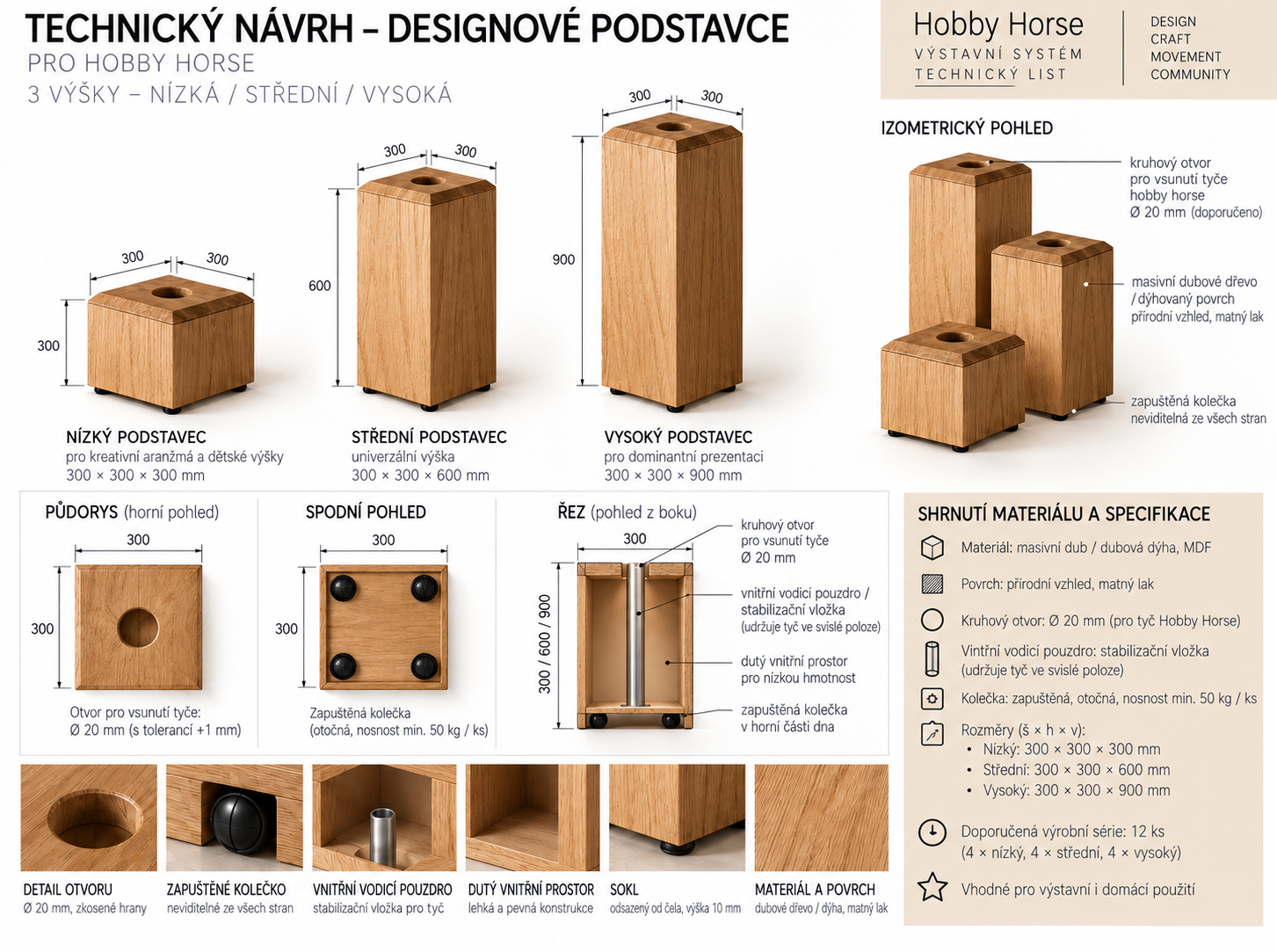
Technical specification
- 300 × 300 × 300 mm
- 300 × 300 × 600 mm
- 300 × 300 × 900 mm
- oak / oak veneer
- natural appearance
- matte finish
- circular opening for hobby horse stick
- internal stabilising sleeve
- hollow interior
- concealed wheels
Current development
developed for submission to Designblok Prague 2027
Can You Still Play? is being developed into a spatial participatory installation for approximately 60 m².
The installation consists of:
- 12 hobby horses
- 12 sculptural pedestals
- 4 × 300 mm
- 4 × 600 mm
- 4 × 900 mm
Each pedestal holds one hobby horse.
Visitors are invited to remove a hobby horse from its pedestal and actively use it.
A physical obstacle course forms part of the installation, transforming the exhibition space into an environment for movement, play and participation.
The project shifts between:
object
→ participation
→ movement
→ play
The installation is completed by the audience.
Can you still play?